At a high level, reconciliation is about one simple question: did what we think happened actually happen, completely and accurately?
In fintech and transaction heavy SaaS companies, it is one of the core ways you make sure the business is recording activity correctly and actually receiving the money it expects.
Reconciliation is one of those functions that sits quietly in the background until something breaks.
Why it matters
Reconciliation helps catch missing transactions, duplicates, bad mappings, settlement breaks, and cash issues before they become bigger problems.
It's not just an accounting thing. Reconciliation supports operations, controls, and trust in the data, and it often helps catch product issues early by surfacing breaks, edge cases, and unexpected behavior back to product and engineering teams.
It also provides the audit trail that internal audit, external auditors, and regulators rely on. When someone asks "how do you know this revenue figure is correct?" or "show me the cash movements for this period," a well-run reconciliation process is what makes that question answerable quickly and confidently.
The two main layers of reconciliation
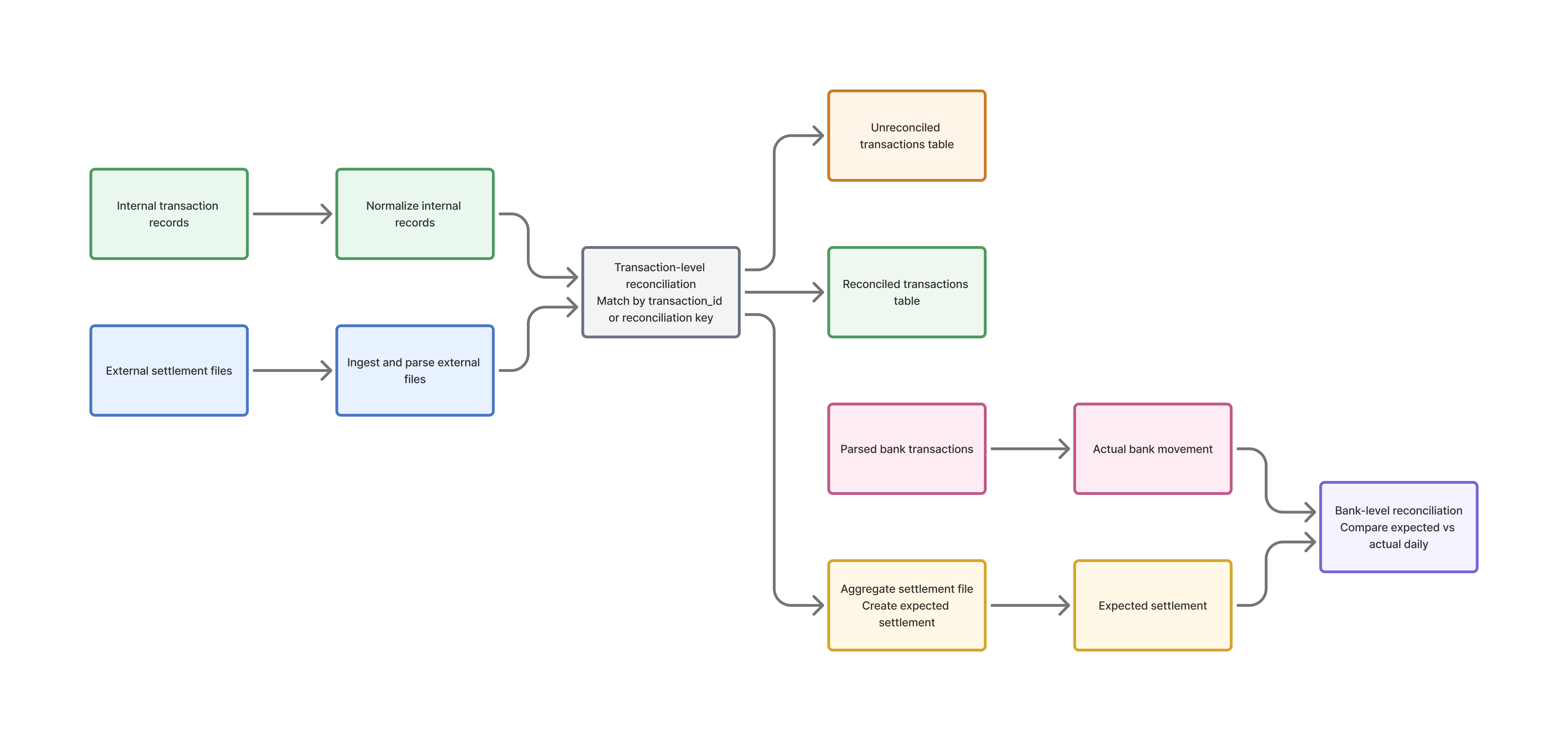
Transaction reconciliation
This is the record level check. You are matching internal transactions against an external source. For example, a settlement file from Visa, a processor, or another partner. The goal is to make sure nothing is missing, duplicated, or mismatched.
Bank reconciliation
This is the cash level check. Once transaction reconciliation is done, you can aggregate settlement activity into an expected settlement. Then you compare that expected amount against actual parsed bank transactions to confirm the money really moved.
The basic flow
- External files arrive from partners
- Internal transaction records come from your own systems
- Both sides get normalized into a common format
- Transactions are matched against each other
- Reconciled and unreconciled records are separated
- Reconciled settlement activity is aggregated into expected cash
- Expected cash is compared against actual bank activity
Where the real work starts
Matching records is only part of reconciliation. The harder part is figuring out what to do when things do not match.
Is it a timing issue? A duplicate record? A broken parser? A missing file? A mapping bug? A partner side issue? Expected business behavior?
This is where reconciliation stops being just a data exercise and starts becoming an operational function.
Common failure modes
- Missing internal records
- Missing external records
- Duplicate transactions on either side
- Amount mismatches due to rounding, currency, or fee differences
- Status mismatches where internal and external systems disagree
- Late arriving or re delivered files
- Broken mappings or join keys across systems
- Bank timing differences and value date misalignments
- Partner corrections that do not cleanly map back to original transactions
Every one of these has its own investigation path and its own fix. Some are yours to fix. Some belong to the partners like Visa, Mastercard.
What companies actually need around reconciliation
Good reconciliation requires more than a matching script. You need:
- Reliable data pipelines that ingest and normalize files consistently
- Clear exception handling for unmatched items
- Operational workflows for investigation and correction
- A way to escalate and work with partners when the issue lives outside your systems
- Finance and accounting alignment on what counts as resolved, what can be booked, and what needs follow-up
In my experience, strong reconciliation is cross functional by nature. It touches engineering, data, finance, accounting, and operations all at once. Teams that treat it as purely a data problem or purely a finance problem usually end up with gaps.
Controls, metrics, and monitoring
A reconciliation process is only as good as its visibility. A few examples of metrics worth tracking:
- File arrival checks - did all expected files arrive on time?
- Duplicate detection - are any files or records being processed twice?
- Reconciliation rate - what percentage of records reconciled by the system vs human? 99%, 99.9%, or 99.99%?
- Unreconciled count and dollar exposure - how much is unresolved right now?
- Aging of open exceptions - how long have items been sitting unresolved?
- Expected vs actual settlement breaks - where is cash not matching expectations?
- Resolution time by issue type - how quickly are different categories of breaks being closed?
The goal is not just to know whether something broke. It is to know where the process is fragile and catch issues early, before they become aged breaks or actual cash discrepancies.
Audit is also a key consumer of these outputs. Internal and external auditors will want to see that exceptions were identified, investigated, and resolved in a timely way. If your recon process produces clean, timestamped records of what was matched, what was broken, and how it was resolved, audit reviews become much more straightforward. If it doesn't, they become painful.
If you want to see this in practice, I put together a streamlit interactive tracer app that walks through bank transaction -> GL -> sub-ledger -> tieout.
Building for scale
As volume grows there are a few design principles to look for:
- Separate ingestion, matching, exception handling, and reporting into distinct stages
- Write reconciled and unreconciled outputs separately so each can be processed independently
- Build repeatable rules instead of relying on manual investigation every time the same pattern appears
- Design for payment method differences instead of assuming all money movement behaves the same way. Cards, digital wallets, BNPL, and bank transfers each come with different file formats, settlement timing, fee logic, and correction behavior, so a reconciliation approach that works for one category will not automatically work for another.
- Treat reconciliation as both a control system and an operational workflow, not just a report
The teams that scale reconciliation well tend to be the ones who invest in the exception handling layer early, before the volume makes it unmanageable.
Closing
Reconciliation is one of those areas that looks straightforward from the outside but gets complex quickly once you are dealing with real transaction volume, real partner behavior, and real money movement.
Done well, it gives a company confidence that its transaction records, settlement expectations, and cash reality all line up the way they should. Done poorly, it becomes a source of operational noise, accounting uncertainty, and partner friction.
I will probably write more on this over time, especially on exception handling, partner operations, controls design, and how reconciliation teams actually work day to day.
If you work in this space or want to compare notes, feel free to reach out at junxu315@gmail.com.